Music for Ads: The Licensing Trap — and the Three-Minute Way Out
Why 'royalty-free' music for ads keeps sounding generic and triggering claims — and how to generate a custom track that sings your product's name, with commercial rights, playing in about a minute.
Every ad account has the same dead hour. The video is cut, the hook is tested, and then you're auditioning music for ads in a stock library — track 4 sounds like track 19, the license page has an asterisk, and the "upbeat corporate" one is already running under thousands of other people's campaigns.
This guide is about killing that hour: what "royalty-free" actually buys you, why every library track sounds like wallpaper, and the route that only became practical this year — a custom track that's literally about your product, with commercial rights, in about a minute.
Sound decides the first second now
TikTok and Reels are sound-on by default, and the stay-or-scroll decision happens in roughly a second. In that second, audio is doing at least half the work — a distinctive opening hit stops thumbs before a headline gets read.
That changes what background music for video ads is for. It used to be filler under a voiceover. On sound-on platforms it's the first thing the brain processes, which means the generic library track isn't neutral — it's a signal that says "this is an ad you've already seen."
What "royalty-free" actually gets you
Worth being fair here, because royalty-free libraries aren't a scam — they're just widely misunderstood.
Royalty-free means you don't pay per play. It doesn't mean free, and it doesn't mean copyright-free. The track has an owner; you're buying a license, and licenses have shapes. Common fine print: web and social use tiered separately from paid advertising, rights that end when your subscription does, per-platform or per-audience-size clauses.
The same tracks are everywhere. A library's most-downloaded page is a list of what your competitors' ads already sound like. Popularity is the product, and it works against you.
Content ID doesn't know you paid. A library track used across thousands of channels gets flagged, and while claims are usually resolvable with your license PDF, resolving takes days. Mid-flight on a campaign, days are the one thing you don't have.
And the quiet, biggest limitation: a stock track was written for nobody. It cannot mention your product, your offer, or your name. People searching for copyright-free music for ads are really searching for "music that can't hurt me" — the ceiling on that music is that it can't help you much either.
Custom music for ads: the three-minute route
The alternative used to mean commissioning a composer. Now it's a text box.
Open melodio.co/business. The brief is one field: what you sell, who it's for, what the track should feel like. Shortcut — paste your website URL and the name, tagline, and tone get read from the site automatically, so the brief half-writes itself.
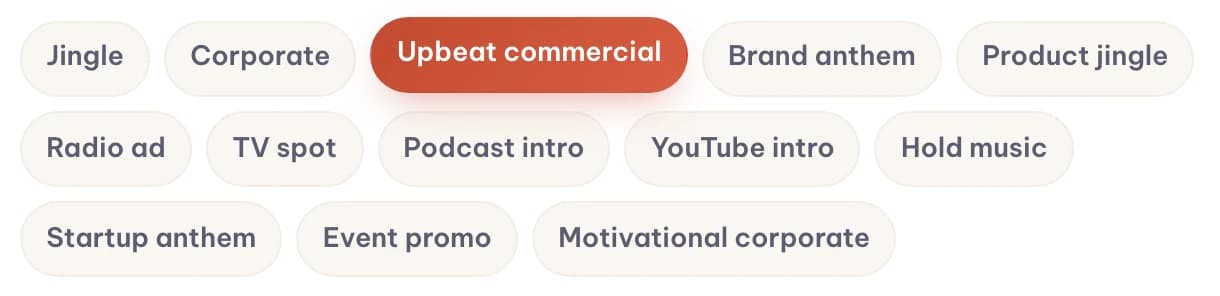
Then pick a format. There are thirteen, each with structure baked in — Upbeat commercial, Radio ad, TV spot, Product jingle, Podcast intro, YouTube intro, Event promo, even Hold music for the retention side of the funnel.
Press create. About a minute later you get two versions of a fully produced track — original lyrics, real vocals, mixed — with a free preview. Iterate like you'd iterate on ad copy: each pass is free, and you unlock only the winner, which comes with download, no watermark, and commercial rights. No tiers, no per-platform asterisks. Running in several markets? The same brief sings natively in 40+ languages.
The one capability no library can match: the hook can sing your product's name. That mechanic is the whole science of jingles, and we've broken it down separately in how to make a jingle.
The brief formula for ad music
Four slots, one sentence:
[Product] + [audience] + [the one line you want sung, in quotes] + [energy level]
Compare:
- 🚫 "Upbeat background music for an ad" — the model has nothing to grab onto. You'll get stock-sounding stock.
- ✅ "A confident 30-second funk track for Stride, running shoes for everyday runners, sing 'built for the long run', 80s bass, high energy."
The quotes matter — the line inside them becomes the sung hook. And the description controls the sound, not just the words: era and instrument vocabulary is production direction. "90s sound," "acoustic guitar," "vinyl crackle," "stadium drums" — each one audibly changes the arrangement, so spend a few words on texture, not just mood.
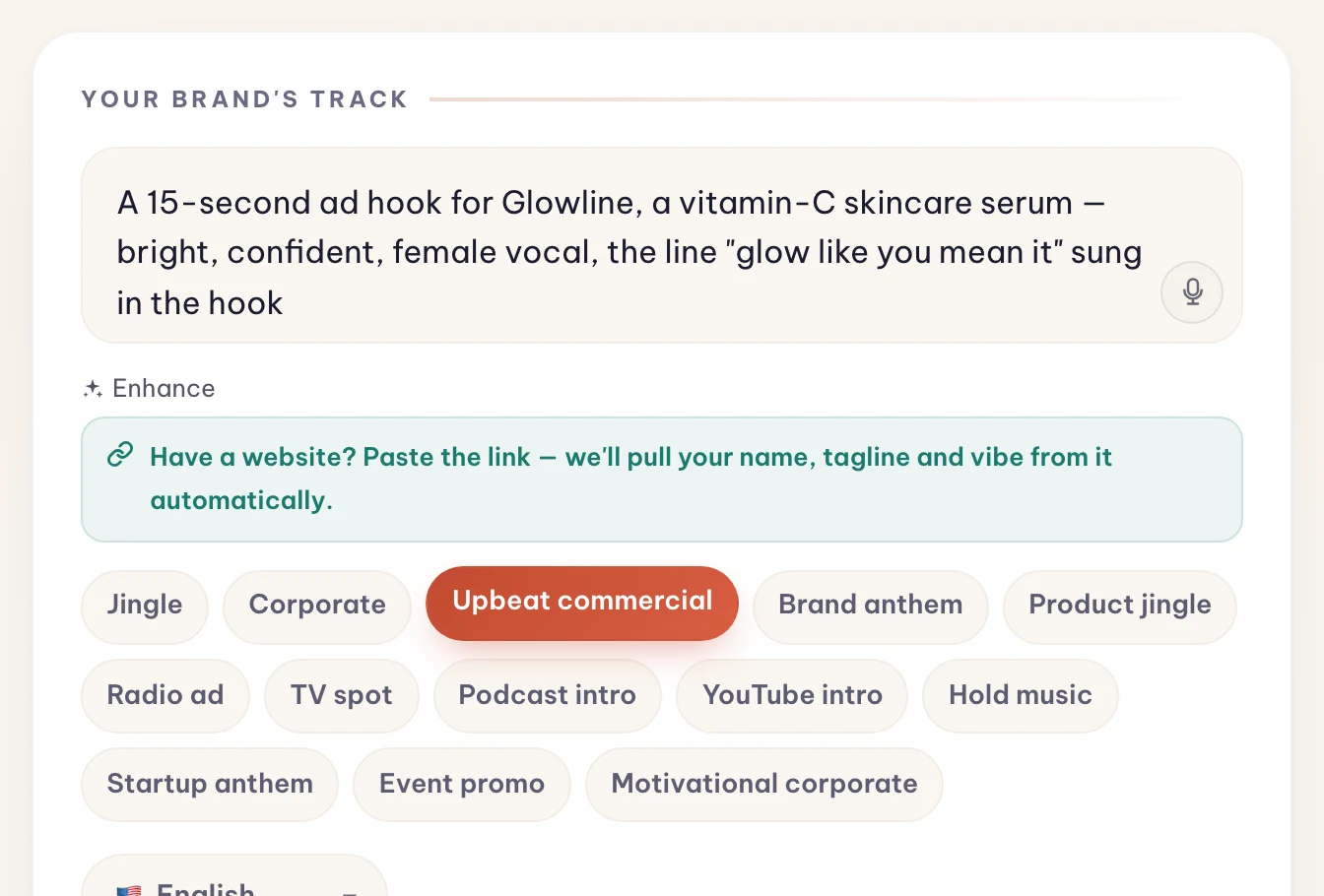
Here's the formula cashed in. One sentence about a fictional serum brand — product, audience, sung line in quotes, energy — and fifteen seconds later the brand has a hook:

The brief: “A 15-second ad hook for Glowline, a vitamin-C skincare serum — bright, confident, female vocal, the line "glow like you mean it" sung in the hook”
Open in Melodio →Matching the music to the funnel stage
This is where most ad music goes wrong: one track, every placement. The job changes as the audience warms up.
Cold traffic — TikTok, Reels, Shorts (15 seconds). Nobody knows you, so the music is the hook. Fast, punchy, name sung inside the first three seconds. Product jingle or Upbeat commercial format; if it doesn't grab in one second, nothing after second one exists.
YouTube pre-roll (30 seconds). You've got about five seconds before the skip button. Front-load: sung name first, then the track can breathe.
Retargeting — Facebook, YouTube (30 seconds). These people have met you; volume annoys, recognition converts. Same sung line, warmer and slower arrangement — familiarity doing the selling. Keeping that line consistent across stages is audio branding in miniature; the full playbook is here.
Podcast mid-rolls. A few seconds of bumper in a listening context. Calm, no big finish — you're borrowing someone's living room, not renting a billboard.
Prompts to steal
"A 15-second, high-energy electro-pop hook for Glow Theory, a vitamin-C serum for women in their twenties — sing 'wake up glowing' twice, bright synths, fast, name in the first three seconds."
"A 30-second YouTube ad track for Iron Oak Gym in Portland, aimed at beginners who find gyms intimidating — warm and encouraging, not aggressive, sing 'strong starts here', acoustic guitar over driving drums, end on the name."
"A 10-second podcast mid-roll bumper for Ledgerly, bookkeeping software for freelancers — relaxed Lo-Fi Hip Hop feel, one sung line, 'Ledgerly does the books', calm confidence, no big finish."
Each names a product, an audience, a sung line, and an energy level. That's the whole trick.
Common mistakes
- Picking the track last. Music chosen at export time becomes wallpaper. Brief the sound when you brief the creative — it's a hook, not a garnish.
- Judging the first render. The model is probabilistic and every generation returns two versions; your second or third pass on the same brief is often dramatically better. Previews are free, so hearing five options costs nothing but minutes.
- Cramming the offer into the sung line. "20% off this week with code SAVE20" is a caption. The chorus gets one idea — usually your name plus one feeling.
- One energy for every stage. The track that stops a cold scroller exhausts a retargeting audience seeing you for the ninth time.
- Forgetting the muted minority. Even on sound-on platforms, some viewers watch silent. Captions carry the message; music multiplies it.
The stock library will still be there tomorrow, with the same most-downloaded page. A track that sings your product's name won't come from it — but it's a minute away.
Make the track your ad deserves
One brief box, thirteen formats, two versions in about a minute — free to preview, commercial rights when you unlock the winner.
Open Melodio Business