How to Make a Jingle for Your Business in 2026 (No Agency Required)
What makes a jingle stick, what agencies charge versus what AI costs, and the exact prompt formula for a 30-second brand jingle that sings your name — with commercial rights.
Quick test: finish this line — "Ba da ba ba ba…"
You didn't have to think. That's a jingle doing its job years after it stopped airing. Sound sticks where visuals slide off, and it's the reason tiny local shops used to pay radio stations for a sung phone number — the singing was the storage format.
For decades that trick belonged to companies with agency budgets. In 2026 it takes one sentence, about a minute, and costs less than lunch. Here's the craft, the math, and the exact process.
Why jingles work (the boring science, fast)
Marketers call it the earworm effect; the mechanics are simple:
- Melody is a mnemonic. Pair words with a tune and recall jumps — it's why you learned the alphabet as a song. A sung brand name is a brand name your customer can't delete.
- Repetition compounds. A 30-second jingle heard weekly beats a billboard seen daily, because the jingle replays itself internally, for free. The whole field of sonic branding is built on this one asymmetry.
- Sound carries feeling. A warm acoustic jingle and a punchy synth jingle can say the same words and communicate two different companies.
What separates a sticky jingle from noise
Having generated a lot of these, the pattern is blunt. A jingle that works follows four rules:
- The name appears at least twice — once inside the hook. If they remember one thing, it must be who you are.
- One benefit, one feeling. Not two. "Great coffee, every day" is a jingle. Your full menu is not.
- A slogan sung verbatim. If you have a tagline, the chorus should be the tagline. Quotes in the brief make that literal.
- End on the name. The last word gets the longest echo in memory.
And two anti-rules: no metaphors (a first-time listener must catch everything at first listen), and no clever wordplay that muddles the name. Clarity beats art here — it's advertising, not poetry.
Agency vs. AI: the honest math
The traditional route: find a jingle house, brief them, wait a few weeks, review two or three demos, pay per revision. Quotes commonly land between several hundred and several thousand dollars, and iteration is where budgets die — every "can we try it happier?" costs real money and days.
The AI route inverts the economics: iteration is the cheap part. On Melodio Business, generating is free and each attempt returns two versions in about a minute. You keep experimenting until something makes you grin, then unlock only the keeper — 10 credits, commercial rights included. The expensive part of jingle-making — hearing many options — has become the free part.
Making yours: the two-minute walkthrough
Open melodio.co/business. The brief is one box.
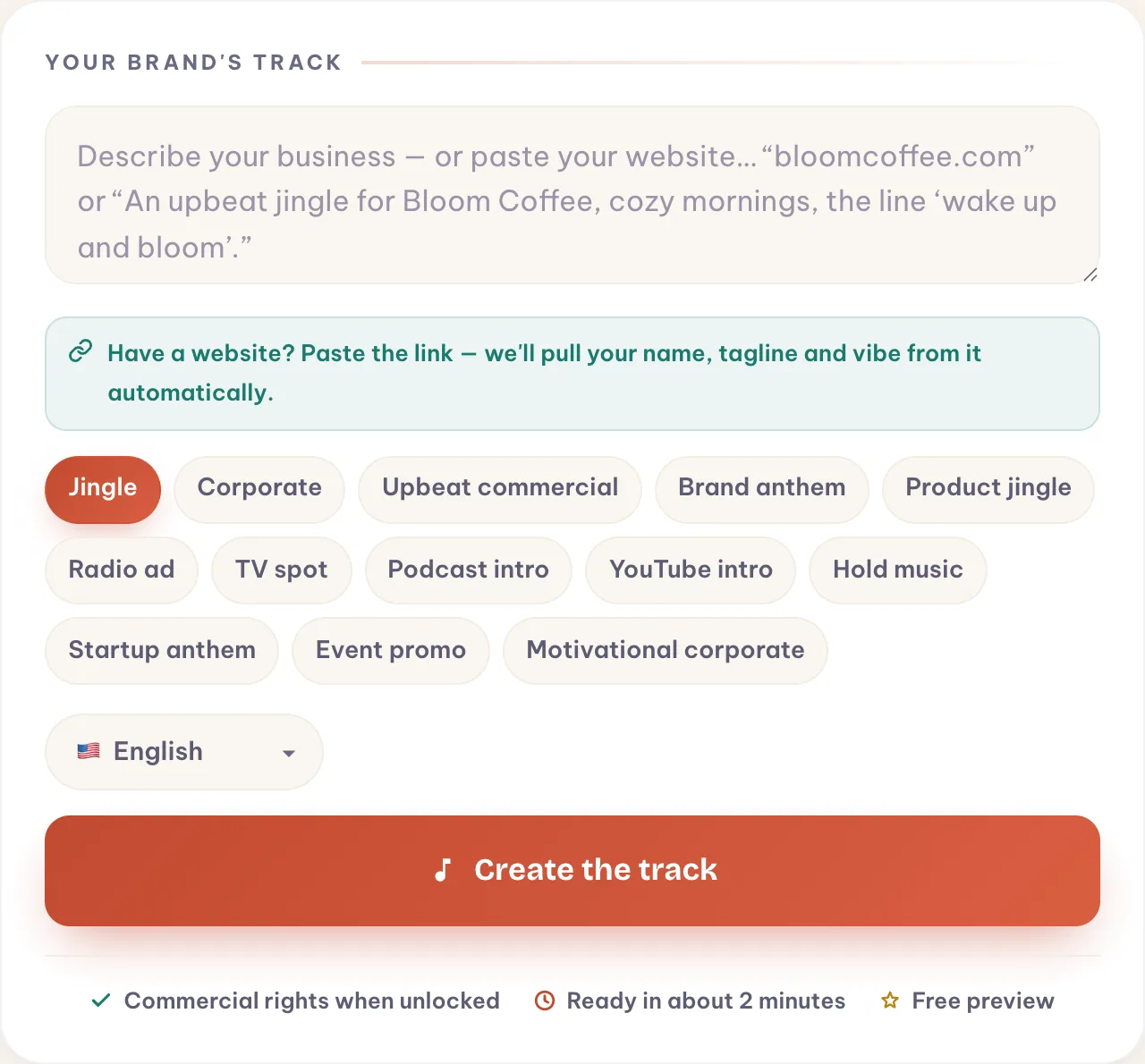
Option A — paste your website. Type yourshop.com and the brief writes itself: business name, tagline, and tone get pulled from the site. Add one line about the mood you want and you're done.
Option B — the prompt formula. One sentence, four slots:
[Name] + [what you do] + [the one feeling] + [slogan in quotes]
Real examples that produce strong results:
"An upbeat jingle for Bloom Coffee, cozy neighborhood mornings, the line 'wake up and bloom'."
"A warm jingle for Harbor Dental, families welcome, calm and friendly, end on 'smile easy'."
Then pick the format. Jingle is the classic 30-second spot; there are thirteen formats total, including radio and TV spots, podcast and YouTube intros, brand anthems, even hold music — each with its own structure baked in (a podcast intro says the show name twice in eight seconds; hold music loops without a jarring ending; an anthem builds verse-to-chorus like a stadium song).
Press create. A minute later: two versions, free preview. Iterate on the brief like you'd iterate on ad copy — happier, slower, more acoustic, male vocal — each pass is free until you unlock the winner.
Where a 30-second jingle actually goes to work
The same track earns its keep in more places than radio ever did:
- Instagram Reels / TikTok / Shorts — your recognizable audio bed under every clip.
- Podcast pre-rolls and YouTube intros — the 8-second version of your brand.
- In-store and on-hold — the two places your most convinced customers are literally waiting.
- Local radio spots — still alive, still cheap in small markets, still works for street businesses.
- Launch videos and event openers — anywhere silence would otherwise be filled with a stock track that sounds like everyone else's stock track.
For the bigger picture on building a brand sound (not just one spot), see our audio branding guide for small businesses.
The checklist
- Name twice, once in the hook, end on it
- One benefit + one feeling
- Slogan in quotes → sung verbatim
- 20–35 seconds; bright exact rhymes
- Generate free, iterate freely, unlock the keeper with commercial rights
Your competitors have a logo. Very few of them have a sound. That gap is one minute wide.